Best brand positioning and messaging software and tools

Summary
Positioning and messaging software is a new niche category. While this work is critical to help a brand stand out in a crowded market landscape, it’s traditionally been a very manual lift for strategists and marketers. There are many products that can help gather pieces of data around a brand’s positioning and messaging but there’s been a big gap on the strategy side. This guide helps tease apart this emerging category to help you find the best solution to support your positioning and messaging work.
If you do any kind of work on a brand – whether that’s internal on your own brand or external on a client’s brand – your success is dependent on the strength and clarity of the brand’s positioning and messaging.
Every point of brand communication depends on positioning and messaging. This includes content across social media posts, blog articles, videos, podcasts, to ad campaigns, to sales conversations – even memes.
Positioning and messaging are the strategic heart of a brand. It makes sure all those efforts align and tell a cohesive, differentiated story to the brand’s audience.
Working on positioning and messaging falls into two camps. Either founders and internal marketing teams handle it or they hire outside help from an agency or consultant.
No matter who’s leading the charge, you need data and frameworks to clarify key components of the brand:
- Customers: who the brand serves and the core needs they aim to fulfill
- Competition: what other solutions exist in the market and what their strengths and weaknesses are relative to the brand
- Offering: how the brand delivers unique, differentiated value to solve the key problems of its target customers
From there you then need to create key strategic messaging to communicate those ideas.
It’s a niche set of challenges that require specific skills and tools.
What are positioning and messaging products?
Positioning and messaging software is a new category designed to help tackle these fundamental strategic needs.
A product in this space has to provide frameworks and data geared toward strategists, marketers, and founders. The goal is to analyze the positioning and messaging of both a brand and its competition. In today’s marketplace, most categories have grown from a handful of key competitors to sometimes dozens of brands. Every one of them aims to steal fragments of market share and mental availability with customers.
It’s a complex challenge to gather and make sense of all the necessary data.
To succeed in this space a tool needs to help surface the most important strategic information about brands clearly and consistently.
Why use positioning and messaging software?
We’re entering into a new age of competition in the market place. The rise of AI continues to make it easier and easier for new brands and products to launch. For existing brands it’s become even easier to copy features and functionality of competitors.
This all adds up to an incredible amount of noise in the landscape. More options to navigate and more options that might look and feel like each other.
Doing positioning and messaging work totally by hand was once a manageable task. In this evolved landscape it’s become unwieldy.
An evolved market place calls for evolved tools.
The benefits of a great positioning and messaging and product:
- Specificity of data: This isn’t about accessing a firehose of every kind of data available. The aim is to access data that’s hyper-focused and can inform key positioning and messaging decisions.
- Clarity of data: The data that’s delivered needs detail without being so dense that it’s impossible to interpret.
- Faster actionable insights: With the volume of competitors to consider speed becomes a critical factor. Analysis and insights need to be quick to manage the scope of brands in consideration.
- Reduction in manual effort: The tool has to make the user more efficient. Take the tedious, repetitive tasks related to areas like research and let the user focus on higher level thinking.
- Differentiation support: At the center of positioning and messaging the goal is to help a brand set itself apart. A great product in this space helps ease this core function.
- Consistent views: Reviewing data across dozens of brands requires a repeatable process that allows you to compare and contrast different solutions and uncover strengths and weaknesses.
- Concept ideation: There should be easy ways to leverage the analysis of a brand to help inform revised messaging and positioning.
- Decision enablement: The data and insights provided need to support action to be of value. Products in this space have to support users to make better, more confident decisions.
- Cost-to-insight ratio: Brands of every size from startups to enterprise need to do this work. Agencies and consultants who focus on these areas need better tools that aren’t cost prohibitive.
13 best positioning and messaging products and tools
As a new niche category most tools that help with positioning and messaging only focus on small pieces of the puzzle. This list looks at a range of products that contribute to positioning and messaging work. For each product we look at their individual strengths, weaknesses, and who the target audiences are.
1. SmokeLadder: Best for researching, analyzing, and clarifying positioning and messaging
SmokeLadder is the only software product focused on data-driven positioning and messaging. The product started from the ground up to tackle these challenges. Its functionality and features all support strategists, marketers, and founders who do the work. While most of the products in this list provide different types of data that can help inform positioning and messaging, SmokeLadder provides both data and frameworks tailored to create clarity around these areas. It leverages AI models informed by a decade of strategic service work from its parent company, Map & Fire.
SmokeLadder provides all the following analysis and insights:
- Fast analysis: Any brand can be analyzed in under a minute. Any data from previously analyzed brands is available instantly.
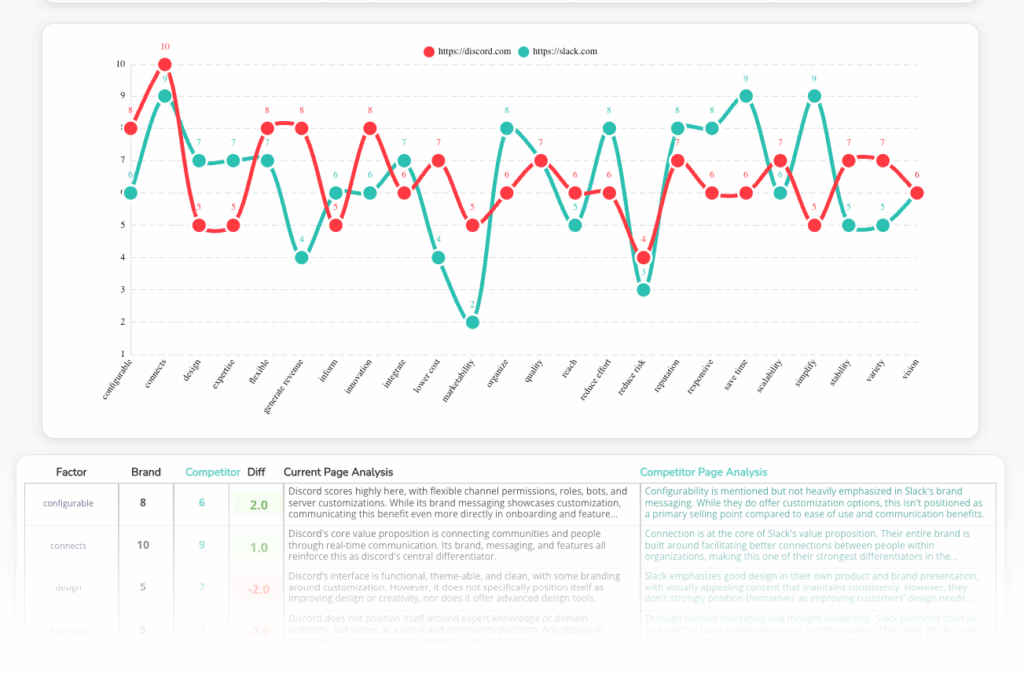
- Positioning value points: Every website gets evaluated across 24 points of customer value (save time, reduce effort, lower cost, integration, marketability, etc.). This creates a consistent scorecard to identify a brand’s specific strengths and weaknesses.
- Differentiation: A brand’s value points help compare and contrast with competitors (and category averages) to discover areas of where the brand has separation.
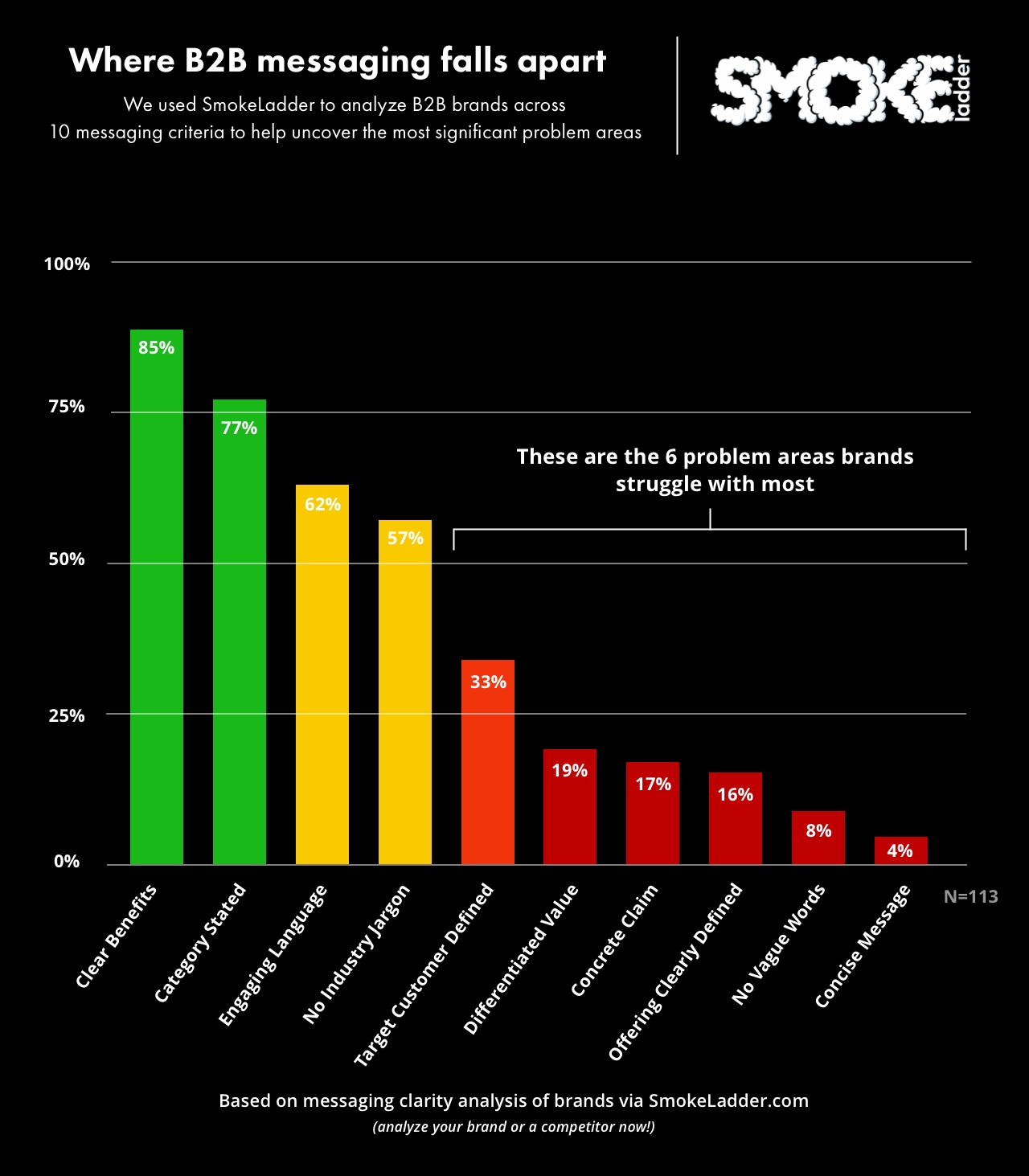
- Message clarity: The messaging rubric scores each brand across 10 criteria to see whether it communicates information on key elements such as: target customer, brand category, offering definition, points of differentiation, as well as its use of industry jargon and vague words.
- Message ideation: The message builder feature takes all the key inputs for a brand and generates strategic messaging concepts.
- Category benchmarks: Based on thousands of analyzed brands, SmokeLadder provides category average scores to help determine whether a brand conforms or separates itself from the baseline.
- Category insights: Insights around the brand’s key competitors, customer needs, and factors that would cause a user to switch from one solution to another are all provided by default.
- Target persona: A brand’s target persona that includes demographic and firmographic points along with typical Jobs to Be Done needs and expectations.
- SWOT analysis: Comparison of the brand against category competitors in a SWOT format to identify both strategic opportunities and challenges.
- Brand brief: Summary of core insights across key areas compiled into a downloadable and shareable PDF to be used internally and with clients.
- Visual analysis: To assess the effectiveness of the brand’s visual communication, there are insights and scores to evaluate its visual quality and specific visual elements, including logo, colors, images, typography, etc.
- Searchable brand archive: Thousands of previously analyzed brands can be searched and reviewed based on their name, category, and specific value point strengths.
- Actionable insights: Positioning and messaging sections allow users to generate key insights from the provided analysis to help interpret the information and inform next steps.
- Weekly email reports: For saved brands, SmokeLadder sends automatic email reports on the brand’s current scores, changes to scores, and information about key competitors to keep users up to speed.
How it aligns with positioning and messaging work:
SmokeLadder is purpose-built for working on positioning and messaging. It provides specific frameworks to analyze a brand’s current positioning and messaging and structures the data to allow for easy comparison between competitors. It also includes insights to help interpret the data and guide next step actions to take advantage of the learnings. It provides deep analysis within minutes and has affordable monthly plans aimed at large and small teams as well as individual consultants.
Who the ideal customer is:
The ideal customers are agencies and consultants who work on positioning and messaging projects regularly for their clients. It allows them to evaluate brands, get up to speed on their strategy, and analyze large groups of competitors. Because of its speed and affordability it’s also a great tool for founders and internal marketers to keep tabs on their own brand and competitive set. Sales teams would also benefit from SmokeLadder to learn about new leads and understand their competitive challenges.
2. BrandWatch, 3. Brand24: Best for tracking social conversation
BrandWatch and Brand24 collect and analyze data points from social media channels so that you can understand interest and sentiment for a brand through the lens of consumers. These insights can help a brand refine its offerings and content to align with the needs of its target audience. This type of software is best suited for large brands that generate a lot of social discussion.
How it aligns with positioning and messaging work:
Understanding how customers think and speak is a core part of positioning. Using their own language is also an ideal touchpoint to help craft authentic messaging and content. While this data helps inform marketing strategy and validate messaging resonance it’s not directly aimed at analyzing and improving a brand’s core positioning.
Who the ideal customer is:
Marketing managers for medium to large brands are the target audience as they have the size to generate enough social conversation to utilize the tools and support their cost.
4. Crayon, 5. Klue: Best for gathering competitor and sales data
Crayon and Klue provide intelligence around competitor products and services as well as analysis of internal sales calls to inform marketing and sales efforts. This information helps brands to stay up to speed on features and pricing of key competitors to sharpen head-to-head marketing materials, create battlecards, and maintain a competitive edge.
How it aligns with positioning and messaging work:
These products tackle another key pillar of positioning with its tracking and insights of the competitive market. Staying up to date on competitor offerings and analyzing internal sales activity allow for marketing and sales teams to position their own offerings in an optimal light in real-time on a sales call. These tools are excellent for enabling internal teams but don’t provide frameworks to craft core brand positioning and messaging.
Who the ideal customer is:
Senior staff who support sales teams at larger enterprises via sales enablement, competitive intelligence, and revenue operations.
6. Semrush, 7. Ahrefs, 8. SimilarWeb: Best for tracking search data
Semrush, Ahrefs, and SimilarWeb focus on providing data and insights around traditional SEO research, search data, and AI search (GEO). SimilarWeb also provides estimated traffic around website traffic. This data helps brands understand how their target audience finds them and improve alignment with their needs. This data helps track and inform strategies around the brand’s content, social, and search ad efforts.
How it aligns with positioning and messaging work:
Search is a valuable channel for gauging demand for products and services and aligning with that demand. It provides insights around terminology and words used by consumers to make messaging more impactful and reverse-engineer positioning direction. This data provides key feedback on performance of content but the tools aren’t designed to craft core positioning.
Who the ideal customer is:
Marketing lead for a brand or agency. These tools have more flexible pricing options that make them accessible for both large and small companies.
9. Wynter: Best for conducting qualitative messaging research
Wynter is a research platform that provides feedback on the messaging and awareness of B2B brands. Like other audience panel products, Wynter allows users to select criteria for their target customer and then survey them on the brand’s content. Wynter prides itself on the vetting of participants in their panels to ensure fit of their roles and experience.
How it aligns with positioning and messaging work:
In order to ensure a brand’s messaging and content are clear and effective it’s crucial to test and validate with your ideal customers. Wynter’s format allows brands to run fast tests before launching to a wide audience. This type of feedback also allows for iterative validation over time. The results focus more on strategic guidance on improvements versus more in-depth strategy and competitive differentiation.
Who the ideal customer is:
VP or director of marketing at a medium to large B2B enterprise.
10. ChatGPT, 11. Claude, 12. Perplexity, 13. Gemini: Best for ad hoc strategy support
Almost every brand now uses off-the-shelf LLM products in at least some capacity. These general purpose tools can help with everything from writing code to brainstorming ad copy. Their greatest strength is in their total flexibility to work on any type of problem. Their weakness is that they’re a classic jack of all trades, master of none. They can access information across any topic however they’re dependent on the user to provide the right question, context, and structure in order to get any kind of useful response. Without that strict level of guidance LLMs may provide responses that are vague, inaccurate, or in some cases hallucinated.
How it aligns with positioning and messaging work:
LLMs can provide support around positioning and messaging work in various capacities. The challenge is that without the constraints and support of specific, vetted frameworks there’s no consistency around the outputs. A standard LLM is also based on text-only responses so it lacks the visual layout to make content digestible. LLMs also have no specific dataset of information or defined scoring system to draw from to help inform deeper insights on competitors and market categories.
Who the ideal customer is:
Any level of strategist or marketer seeking base-level feedback and support.
Key features for a great positioning and messaging product
Positioning and messaging are complex strategic concepts that require research, context, and frameworks, across a wide range of inputs. There’s then a level of crystallization required to make that information actionable. This is why positioning and messaging work has historically been done manually via senior-level strategists and marketers.
The features you should focus on when evaluating a product in this space are:
- Clear frameworks: This provides the consistency and structure to organize data across the core brand and competitor brands
- Category data: Not all brand data is equal when it comes to positioning and messaging. You need data about customers, their needs, the competition, the category, and the value of a brand’s offerings. And you need a breadth of data to identify strengths and weaknesses of brands across a range of categories.
- Easy-to-use interface: The product should make data digestible for the user. The easier it is to access data and insights the more efficient you’ll be with the tool.
- Fast results: Because you need to analyze the parent and a list of competitors the speed to insight factor is critical.
- Shareable insights: This work can’t exist in a vacuum. You’ll need ways to share results with others whether that’s a client or other members of the team.
The rise of the positioning and messaging software category
Positioning and messaging work is only growing in importance. Competitive noise is at an all-time high and it’s getting more intense every day.
While this category only has one clear leader at the moment with SmokeLadder, there are other products that are adjacent and can help provide additional support to the work.
The key is to use tools that help you identify, refine, and communicate the unique qualities of the brand you’re working on quickly and easily so that you can keep that level of differentiation sharp as the landscape evolves.