Welcome to the Category Flood: Why Differentiation Has Never Been Harder
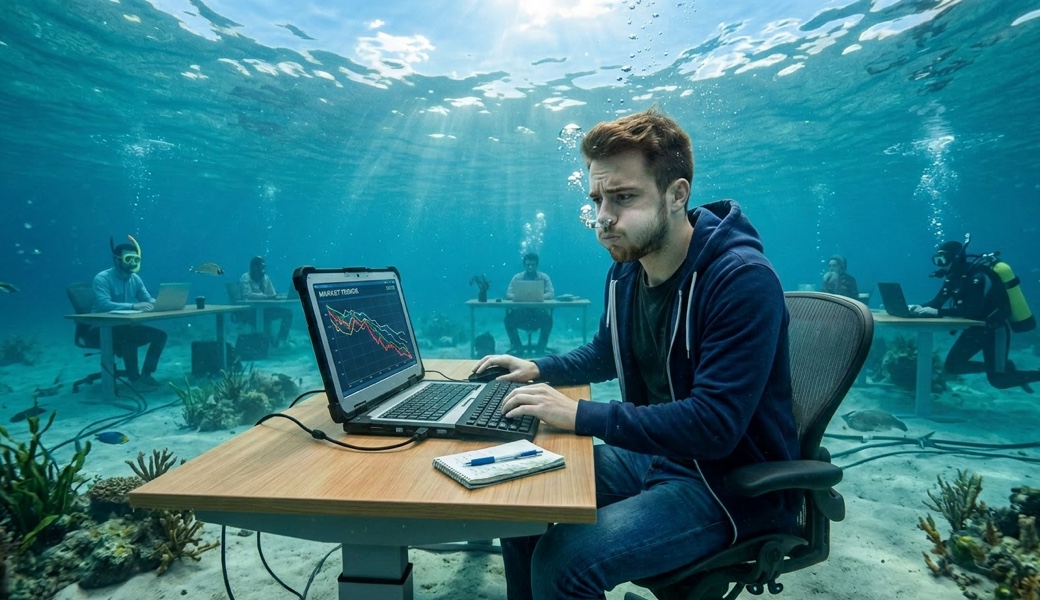
If you work on brands regularly as a marketer or strategist this pain should feel very familiar. Here’s the scene:
You’re tasked with some new marketing effort for the brand – website refresh, a new ad campaign, social content, SEO/AEO, conversion optimization, etc.
To tackle this, the first thing you need to do is get clear on the positioning. What is the brand’s unique value? What meaningful differentiation exists to help this brand catch the attention of its target audience and get them engaged?
Unfortunately, the brand hasn’t figured this out.
So you crack open the typical sources: review sites, Google search, your favorite LLM, and start to gather a view of the landscape.
Market leaders, challenger brands, smaller upstarts.
It starts with a few notes until you realize you need to upgrade to a spreadsheet. Within minutes you have 10, 15, 20 competitors all competing for the same space, and all saying a lot of the same things.
For this work to have any kind of impact the brand needs real differentiation.
But finding it in these conditions sends your brain swimming.
There’s a reason for this.
The Category Flood
Category Flood is a condition in which a category is filled with so many brands competing around the same points of value that buyers can’t meaningfully distinguish one from another.
In other words it’s a combination of:
- The volume of competitors
- The overlap in their offerings
The result is that all the brands become stuck under water. The buyer’s view of the landscape is one homogenous pool where all the brands in it blend together.
For these brands, their marketing isn’t seen and their sales efforts either sink or drag on in endless cycles.
Differentiation has always been a core challenge in marketing.
But the era we’re in now has hit a new level of crisis.
Proof of the Rising Water Line
There’s no shortage of data on the volume of competitors out there.
15 Years of the Martech Map
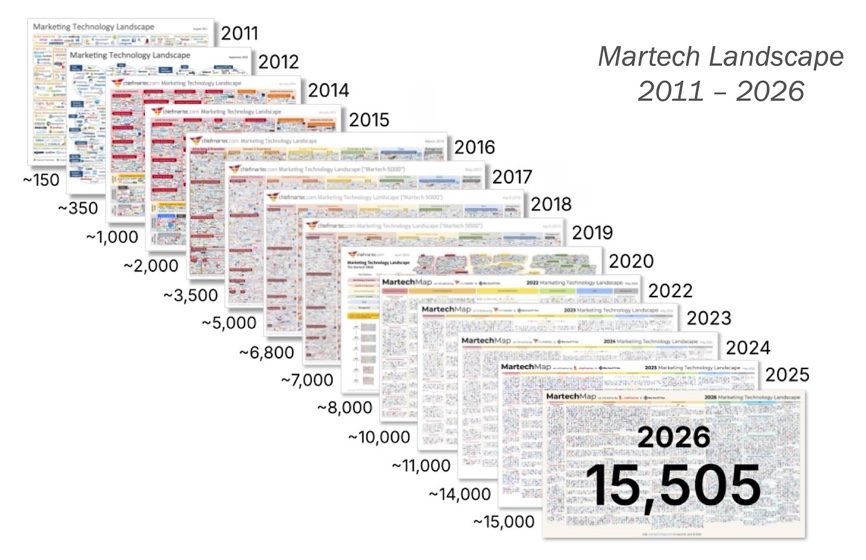
The canary in the coalmine for this problem over the last 15 years has been the Martech Map.
Scott Brinker, founder of Chiefmartec, has been tracking the number of marketing-centric products in the landscape since 2011.
Over that time, the chart has grown 100X, from 150 products to now over 15,000.
As of 2026, for the very first time in that span, it’s seen a plateau. In other words, around the same number of products entered the space as products that churned or drowned.
The 1488 products that were added were the least amount in the last 4 years. And the 1367 that died were the most in the last 4 years. This resulted in just a net gain of 0.7%
On top of that it’s notable that 45% of the companies that churned were between $1MM-10MM ARR. So these were not just tiny startups, but rather companies that had seen real growth but couldn’t sustain it.
They were swallowed up by the flood conditions.
Review Site Saturation
You can also look at sources like the software review site G2 to see that they now support nearly 800 categories of products. Every one of those categories is filled with new entrants working to grab market share and mindshare.
On the services side it’s no better.
The website Clutch provides reviews and scores for agencies. Currently their Web Developer category includes 91,000 companies. Digital Marketing has 126,000. And the Design Agency category has 140,000.
The 5-5 Squeeze
We’ve also been studying the issue of overlap in competitor positioning.
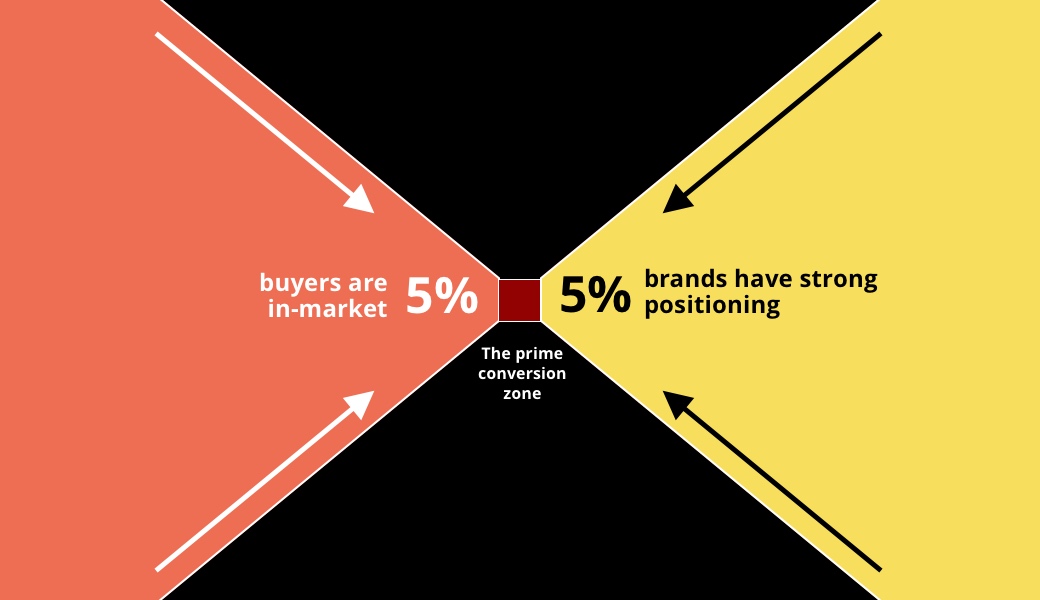
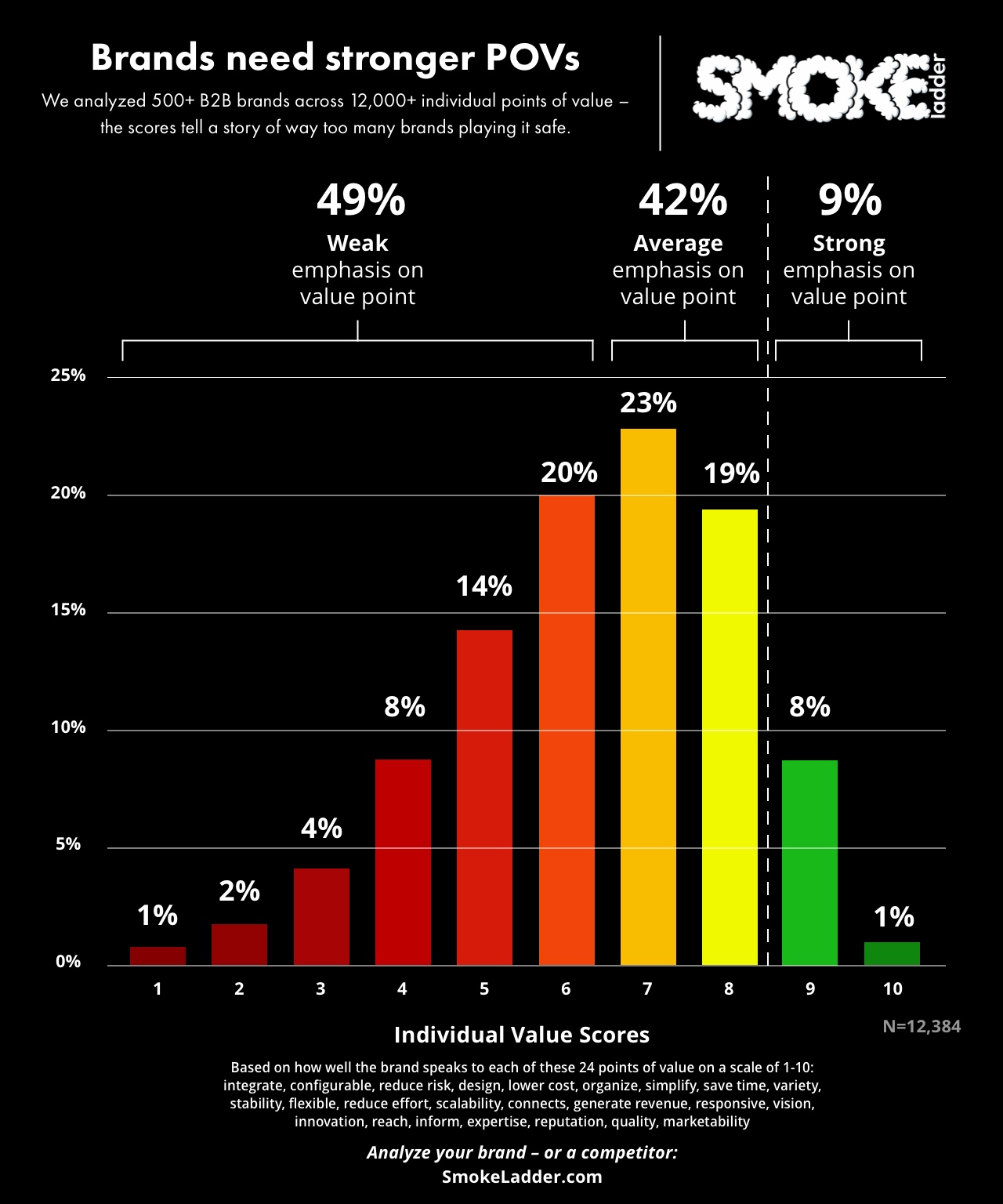
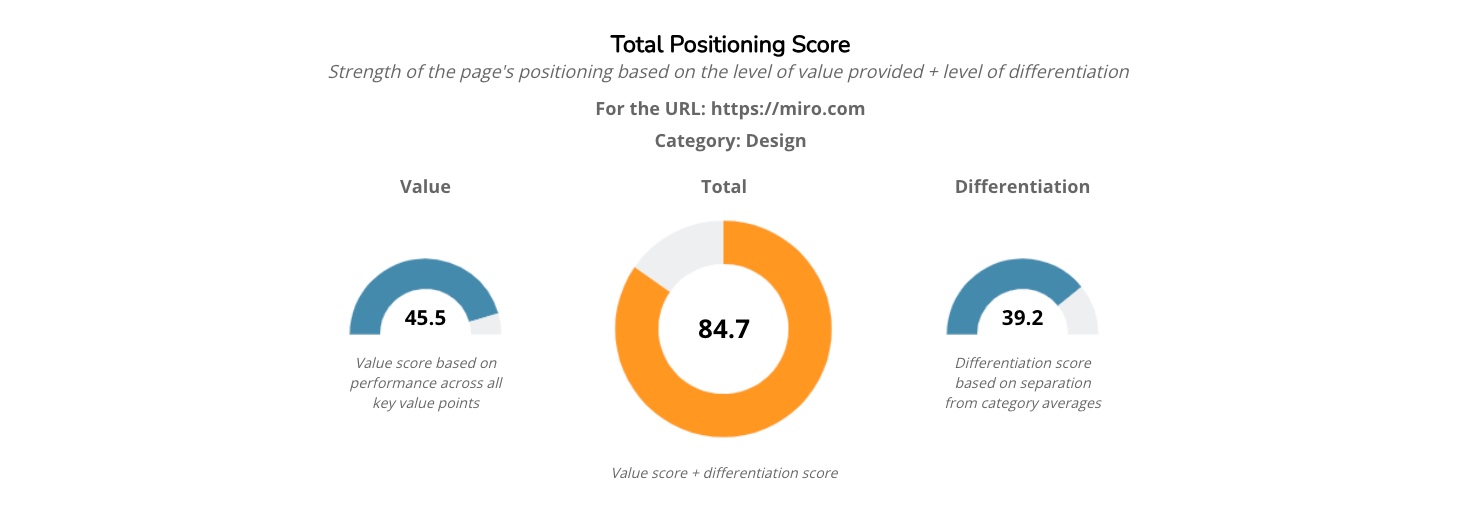
Our own data also shows the intensity in the overlap of positioning. Analyzing the value and differentiation strength of 500+ brands we found that only 5% had strong positioning.
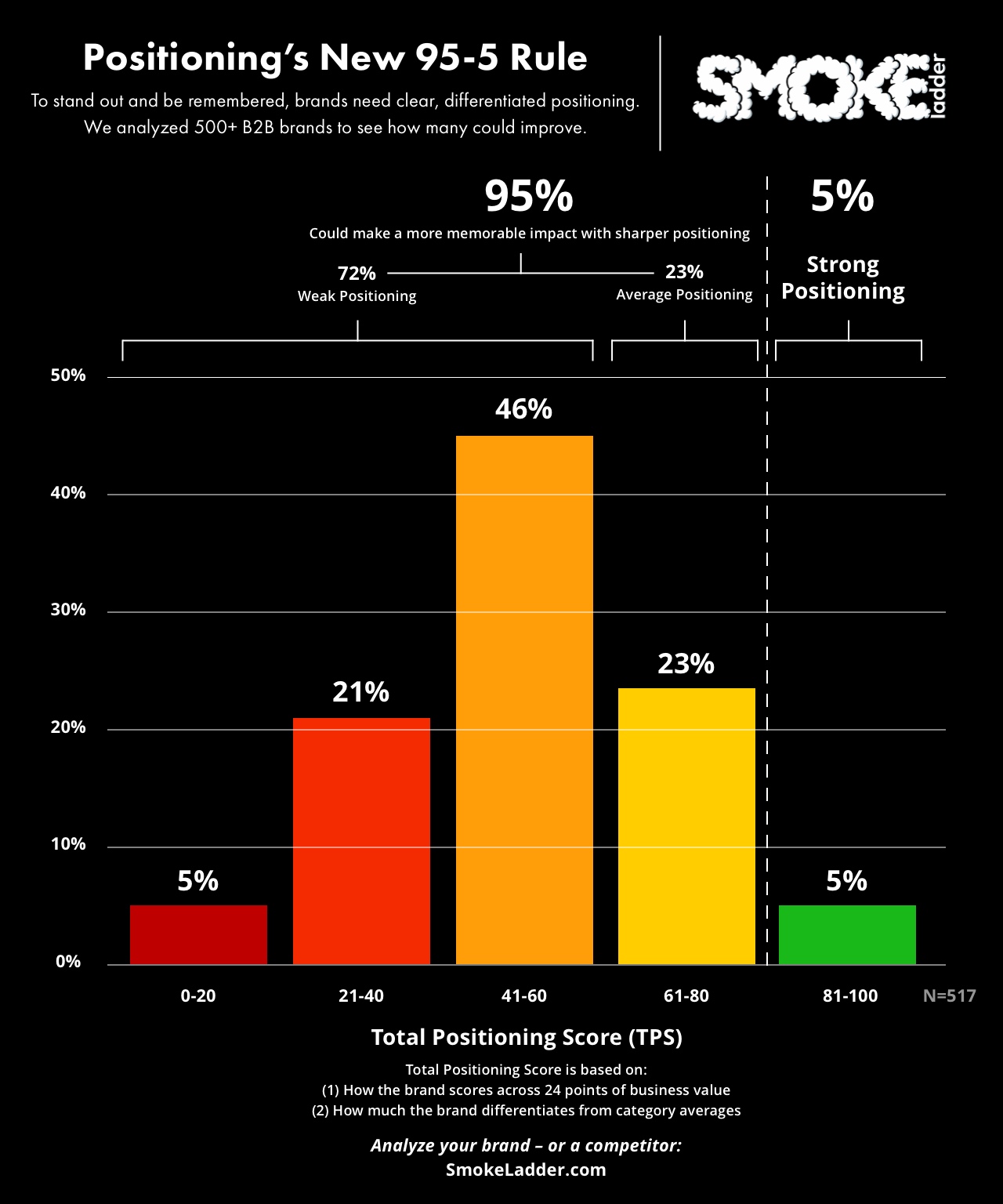
This prompted our concept of The 5-5 Squeeze – i.e. only 5% of buyers are in-market at a given time, and only 5% of brands are in a strong position to attract them.

And this is all before we take into account what AI brings to the table.
The water level isn’t going to keep rising at a normal rate.
We’re now seeing a tsunami level injection of new competition.
There are multiple factors that contribute to this.
What Drives A Category Flood
Category Flood drivers come from both outside and inside the brand.
AI-Driven Development
Externally, new brands are constantly being developed to try and capture a portion of these categories. As mentioned above, the introduction of AI accelerates this at levels we’ve never seen.
Claude Code and Lovable, to name two, allow technical and non-technical teams to build entire products and brands. What used to take months or years can sometimes be spun up over a weekend.
Brands Table-Staking Themselves To Death
There are internal behaviors to consider here too.
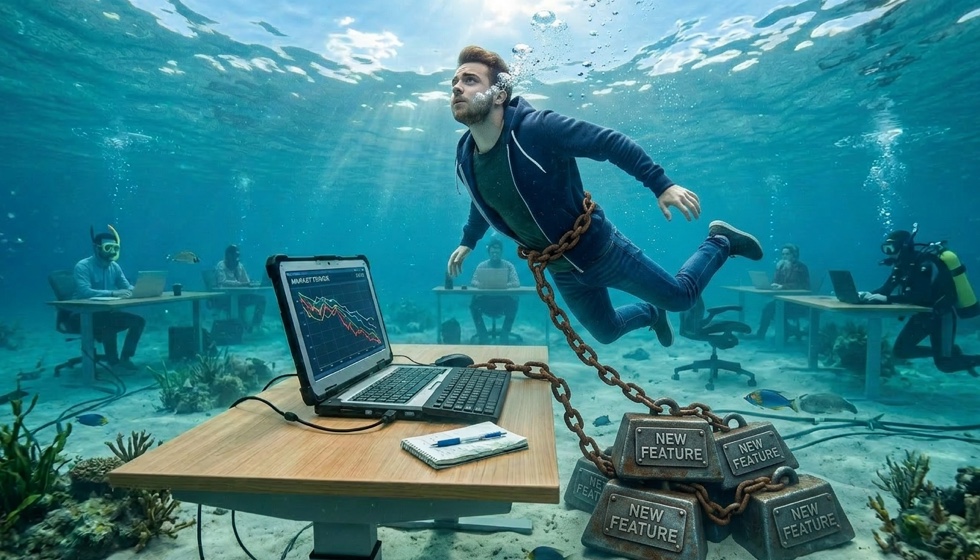
Feature-chasing accelerates category flood. Brands see what their competitors offer and in fear of losing ground, play copycat by adding similar functionality to their own product or service.
This is another place where AI becomes the ultimate accelerant. In the same way a team might create a new product, they can also spin up a matching feature set.
The result is a brand table-staking itself to death.
In other words, rather than building up to get above the water line, they build out and create more and more weight that anchors them to the bottom.
Brands Don’t Recognize They’re Underwater
Author David Foster Wallace once shared this parable at a commencement speech:
Two young fish are swimming when an older fish comes by and says, “Morning boys, how’s the water?” The two fish swim a bit more, then one turns to the other and says, “What the hell is water?”
Brands get so deep in the flood that they lose perspective on the problem.
Part of this is because brands, by default, tend to be much more focused on themselves than the competition.
This leads to brands not giving proper attention to competitors. Without clear, consistent ways to track the competition it creeps up over time.
Weak Support From Leadership and Tools
Even when you recognize the need for better differentiation it’s tricky to fix.
At the agency level you only have a few options: take the brand’s strategy at face value, sneak in time for research and eat the costs, or ask for more budget to do the work properly knowing the client will almost definitely push back.
And when you look at potential tools to help, they’re not built to solve competitive differentiation:
- Generic LLMs lack the context, frameworks, and competitive data to provide real insights on differentiation
- Competitive Intelligence tools provide outputs for sales conversations (battle cards, objection handling, etc.). They tell you how to win a deal not how to create a differentiated brand strategy.
With all this in mind, what are some strategic ways to address it?
Getting Above The Water Line
Every brand out there has to deal with deep competitive waters on some level. Here are some strategies to survive:
Release the Feature-Match Anchor
At a time when technology makes execution easier than ever, the urge to add endless functionality is more powerful than ever.
While competitors add bloat and weight that anchors them to the bottom, you can win by resisting the table-staking temptation.
It’s critical to invest resources in areas where the brand either has a clear advantage or there’s an open space of underserved customer needs.
Building the right things – and even building less – becomes a massive strategic advantage.
Evaluate and Track Competitors Consistently
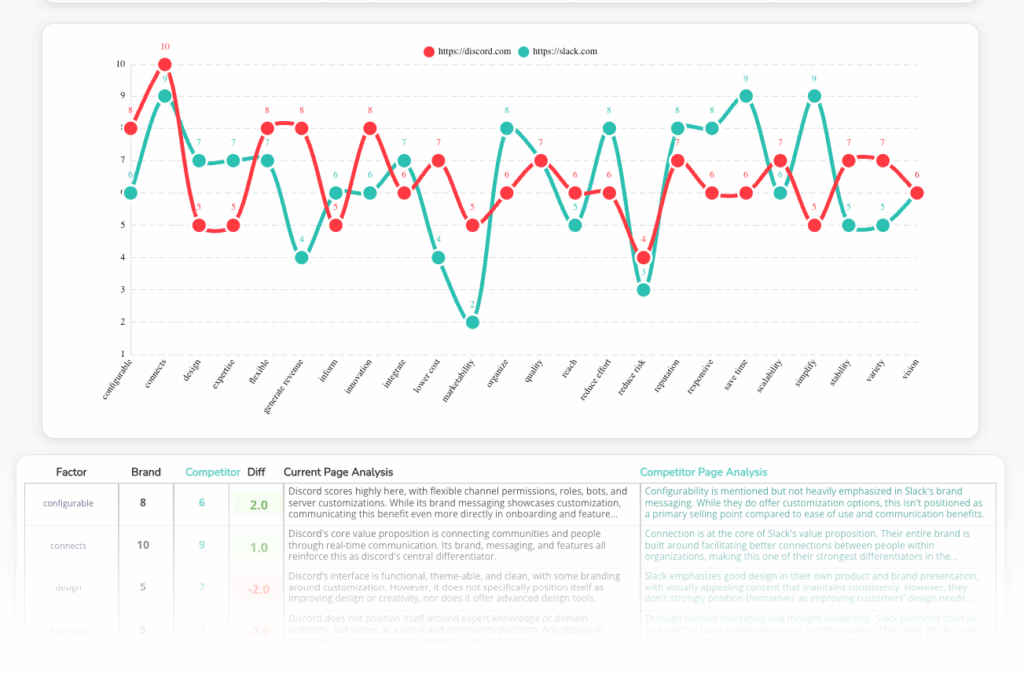
Every brand needs a clear view of the competition. Buyers evaluate the value of a brand relative to the other solutions they could use.
Effective competitive analysis requires two types of consistency:
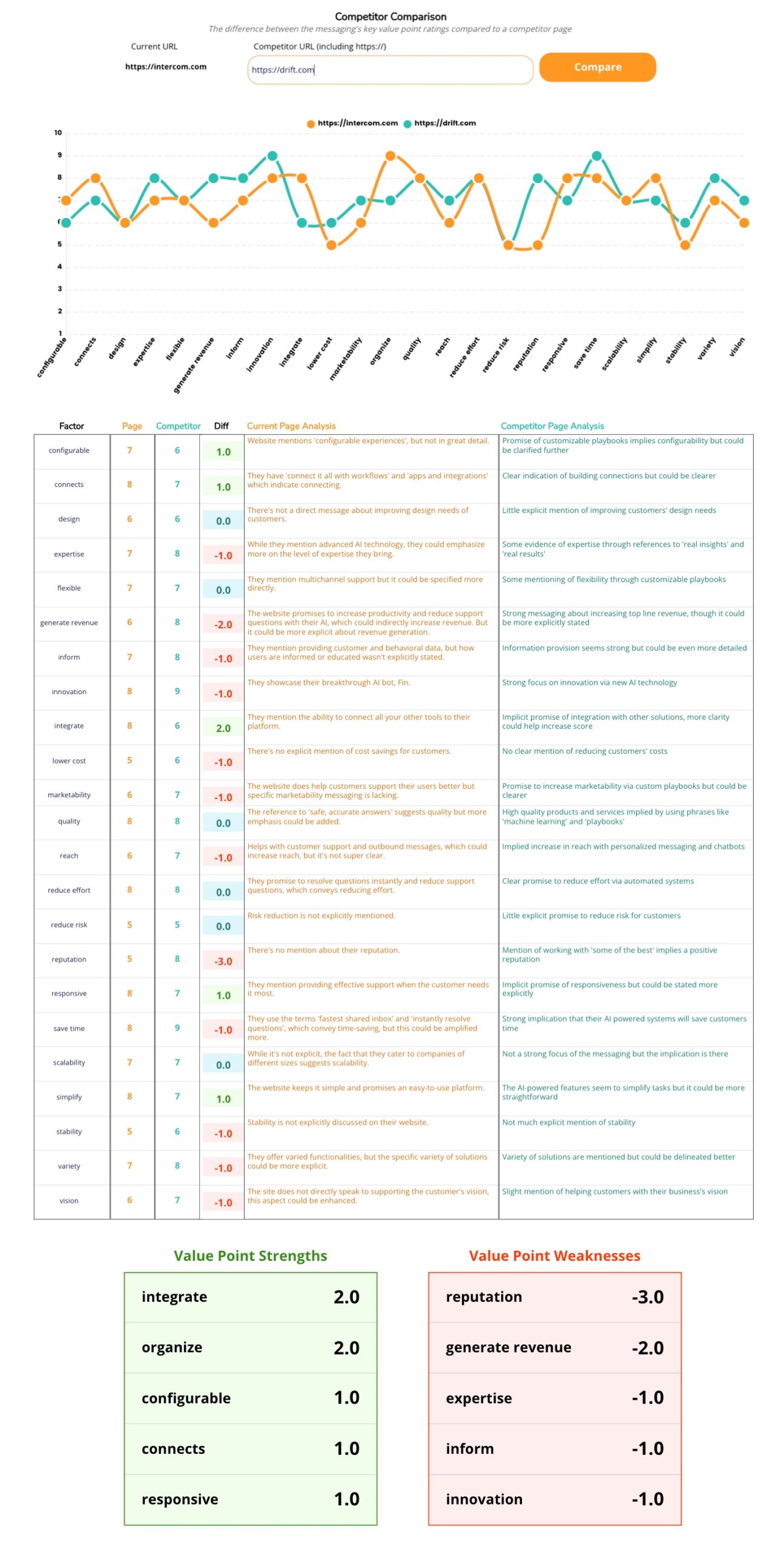
- A consistent, apples-to-apples way to evaluate a brand and its competitors against each other to understand relative strengths and weaknesses
- Conducting this analysis on a consistent basis so that changes in the category and landscape don’t go unnoticed
When you’re underwater, this is the periscope to get a better view.
Create Higher Ground
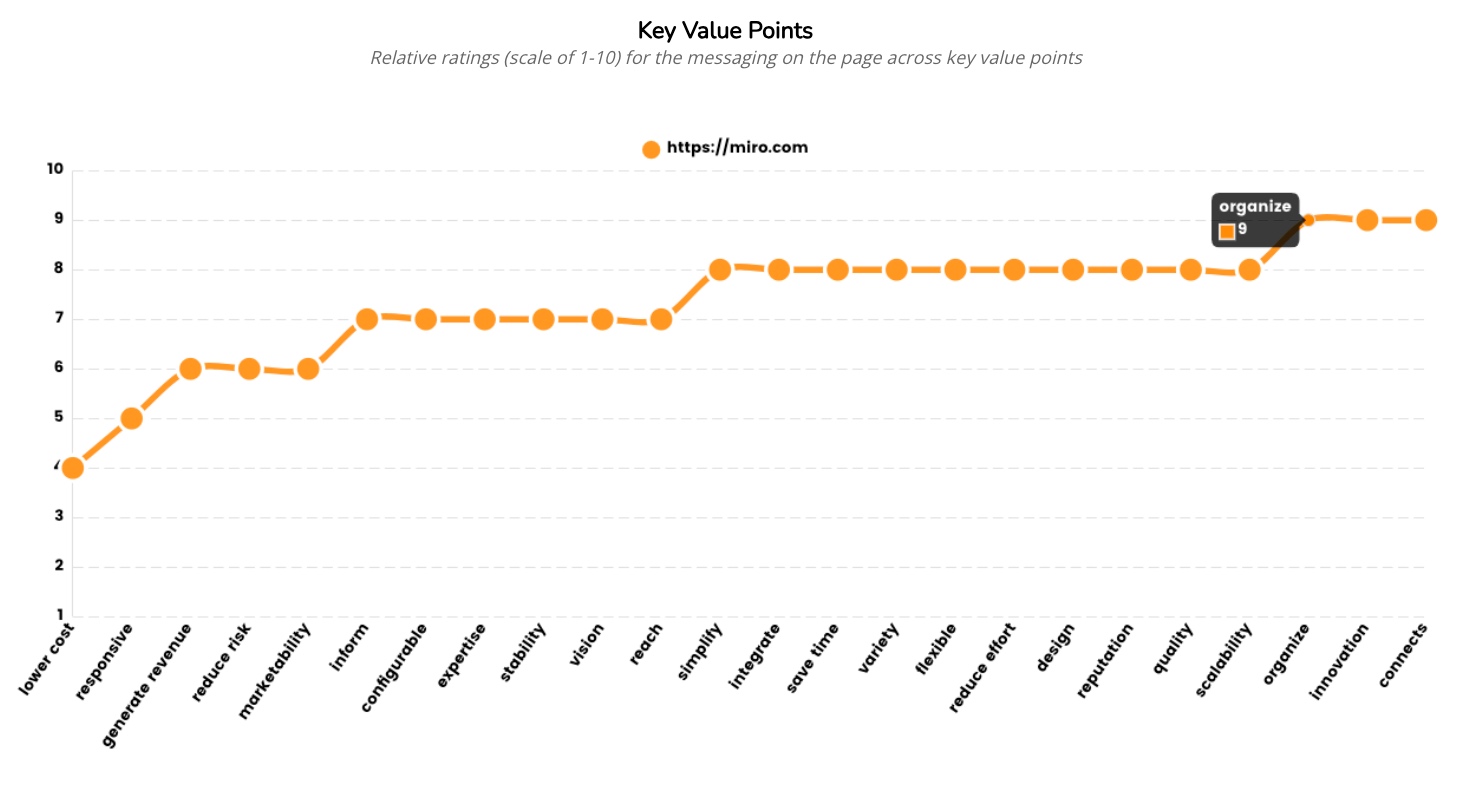
The ultimate fix is to get above the water line. It’s one thing to know you should build up, but the real value comes from understanding how and where to do that. In other words, what areas of strength the brand can double down on so it’s seen and remembered.
With clear, consistent analysis a brand can narrow in on where:
- It delivers value at a high level for its customers’ most important needs
- It has the most separation from the competition
Building these skills and habits might be the most important thing brands can do to get the oxygen they need to survive.

Flood Levels Only Go In One Direction
The Category Flood is not going away and the water is only getting deeper. This means more and more brands will be stuck underwater out of sight and out of mind.
It’s up to internal leadership along with the teams that support them to recognize this problem and embrace it head on.
The brands that survive in the coming years won’t be holding their breath waiting for this to pass. They’ll be the ones building higher ground while everyone else keeps adding weight.
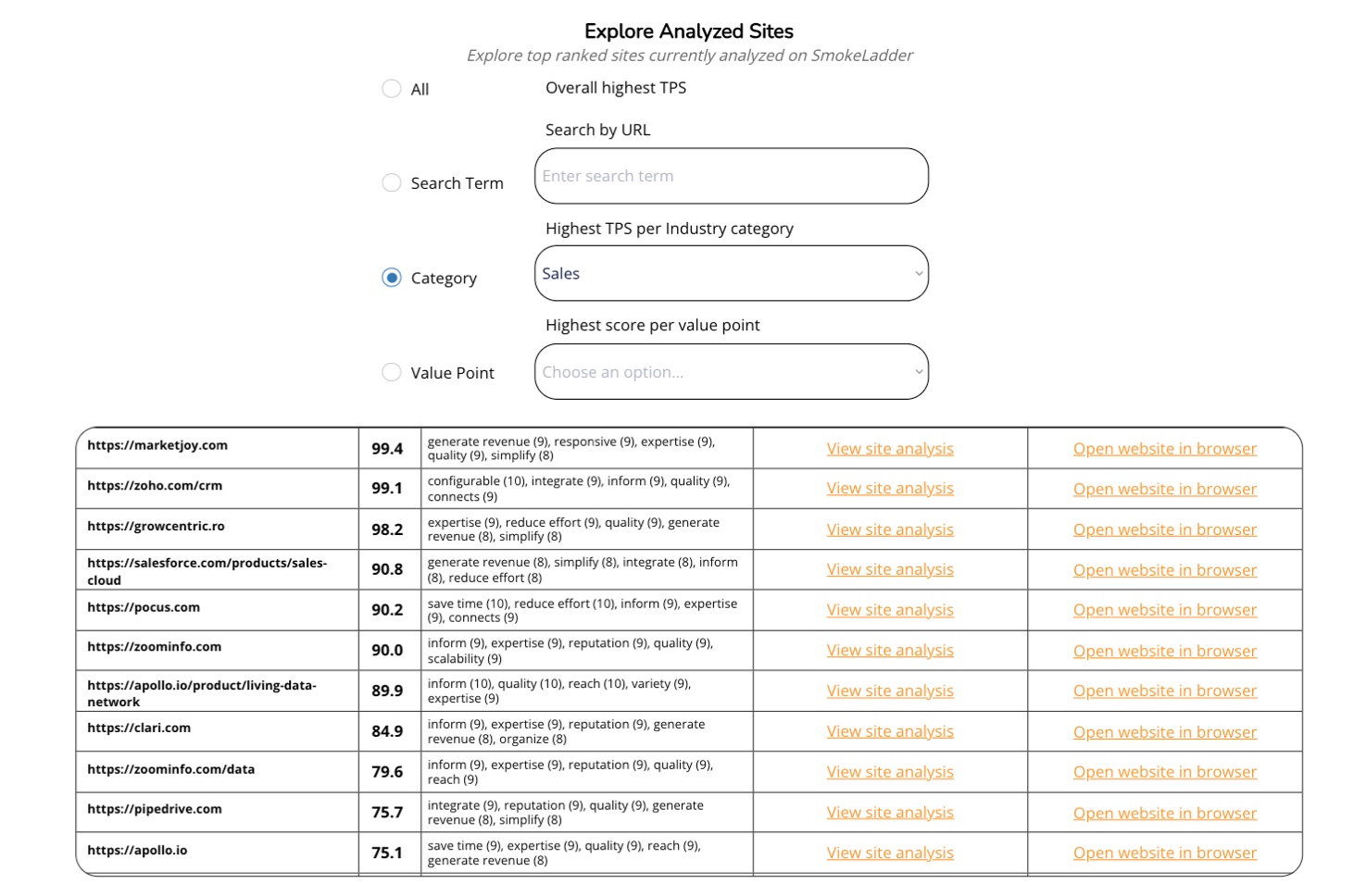
If you want a consistent way to analyze the competition and get context-rich analysis for new types of differentiation, try smokeladder.com